New Energy, New Idea, New Life

Views: 0 Author: Site Editor Publish Time: 2026-06-29 Origin: Site


Selecting the right hardware is only half the battle. Physical deployment dictates overall project success, user accessibility, and long-term viability. You risk creating bottlenecks and frustrating users before the first vehicle even plugs in when spatial dynamics are ignored. Choosing between wall-mounted and floor-mounted pedestal units impacts structural requirements, trenching budgets, and local compliance standards. A mismatch between your chosen hardware and site topology inevitably leads to installation delays and poor user adoption. You compromise safety if you force a pedestal into a cramped garage or place a wallbox too far from a parking bay. This guide provides an evidence-based framework to evaluate site constraints and compare installation realities. You will learn how to assess structural readiness and strict accessibility rules safely. Ultimately, you will discover how to select the exact form factor matching your specific infrastructure goals perfectly.
Cost vs. Flexibility: Wall-mounted units eliminate expensive concrete trenching but are strictly limited by proximity to existing structures.
Scalability: Floor-mounted pedestals allow for strategic placement in open parking areas and easily support dual-port configurations for higher volume.
Compliance: Both form factors must meet strict local accessibility guidelines (e.g., ADA compliance in the US), but pedestal placement often requires more deliberate spatial planning to accommodate wheelchair access.
Physical infrastructure limits directly impact the initial capital expenditure of your EV rollout. Evaluating an AC Charging Station requires more than reading a specification sheet. Site topology decides where equipment can safely operate. You face significant cost hurdles when infrastructure requirements clash against physical site realities. Poor placement strategies force unnecessary construction work. Smart spatial planning prevents these expensive disruptions.
Hardware costs are negligible compared to civil engineering requirements. The capital trap lies hidden underground. Improper placements demand extensive trenching, conduit routing, and concrete pouring. Tearing up asphalt requires heavy machinery and specialized labor. You multiply deployment budgets rapidly when routing power across open parking lots unnecessarily. Relying on existing structural assets minimizes these heavy construction needs. Careful planning keeps conduit runs short and manageable.
Defining a successful deployment requires clear benchmarks. You must evaluate multiple operational layers to ensure long-term viability. Focus on metrics driving user satisfaction and operational efficiency.
Minimal Structural Disruption: Utilizing existing walls and electrical panels prevents invasive construction and accelerates project timelines.
Optimized Parking Turnover: Strategic placement ensures vehicles can enter, charge, and exit safely without obstructing traffic flow.
Scalable Power Routing: Future-proofing the installation involves sizing conduit and panels adequately for subsequent expansion phases.
Wall-mounted installations utilize existing walls, solid pillars, and building facades to host your Electric Vehicle Supply Equipment (EVSE). This approach anchors the hardware directly to adjacent structures. You eliminate the need for freestanding metal structures entirely. Facility managers often prefer this route for adjacent parking bays. It leverages existing building footprints effectively. You can deploy an AC Charging Station quickly when structural supports already exist near the parking area.
The operational benefits heavily favor capital preservation and space efficiency. Many site owners lean toward wallbox units for their simplicity.
Drastic reduction in civil works: Conduit can run directly along existing walls. This completely avoids digging up parking lot surfaces.
Smaller physical footprint: Wall units remain flush against boundaries. They represent the ideal choice for tight indoor garages or dense fleet depots.
Weather protection advantages: Building facades often provide structural canopies. Overhangs shield the hardware from direct rain, snow, and extreme sun exposure.
Despite their efficiencies, wall-mounted setups present specific operational hurdles. You must evaluate structural integrity and pedestrian safety before drilling.
Cord management challenges: Reaching vehicles parked further away stretches cables across walkways. This creates severe tripping hazards for pedestrians.
Structural verification needs: You must verify wall load-bearing capacity and material composition. Drywall cannot safely support heavy EVSE equipment without reinforced backing blocks.
Vehicle collision risks: Exposed wall units risk direct bumper impacts. Installations require proper wheel stops or sturdy steel bollards to prevent accidental crushing.

Floor-mounted chargers function as standalone units bolted securely to concrete pads. You typically find these pedestals deployed across open parking environments. They stand independent of main buildings or support pillars. This form factor excels in expansive outdoor lots. Planners use pedestals to bring power directly to the vehicles. You dictate the exact location rather than letting existing walls dictate placement.
Pedestal units offer exceptional spatial adaptability and user engagement features. They serve high-traffic areas exceptionally well.
Maximum placement flexibility: Installers can position pedestals exactly between parking bays. This ensures multiple spaces share a single access point efficiently.
High visibility potential: Standalone towers act as visual beacons. They offer excellent branding opportunities for retail locations or public charging sites.
Native dual-port support: A single pedestal often hosts two charging cables. This maximizes charging availability per square foot and optimizes underground wiring efforts.
Deploying floor-mounted systems introduces complex engineering demands. Open-air exposure and heavy construction alter the project scope significantly.
High baseline installation barriers: Pedestals require core drilling, deep trenching, and new concrete pouring. These civil works escalate initial project budgets rapidly.
Environmental vulnerability: Standalone units face threats from snowplows, landscaping equipment, and direct vehicle impacts. Robust bollard protection becomes an absolute necessity.
Durability concerns: Cable retraction mechanisms endure harsh elements constantly. Internal springs and pulleys must be aggressively weather-proofed for long-term durability.
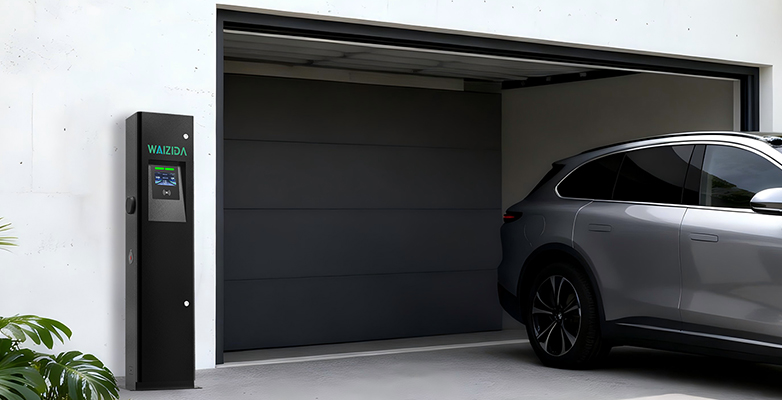
You need a structured framework to compare deployment options objectively. The physical form factor alters project timelines, civil engineering needs, and user experience. We use specific evaluation dimensions to measure the practical impacts of each mounting style. The matrix below outlines the stark differences between these two approaches.
| Deployment Feature | Wall-Mounted Units | Floor-Mounted Pedestals |
|---|---|---|
| Civil Works Need | Minimal. Uses surface conduit. | High. Requires deep trenching. |
| Space Utilization | Zero floor space consumed. | Requires dedicated concrete pad. |
| Port Density | Typically single port per unit. | Often dual-port capable. |
| Impact Vulnerability | Low to moderate. Protected by wall. | High. Exposed on all four sides. |
Running conduit defines the bulk of your installation budget. We must compare the linear foot cost of different wiring methods. Running surface-mounted conduit along drywall or brick walls remains highly efficient. Electricians simply anchor the pipe directly to the existing facade. This keeps labor hours low and avoids destructive demolition. Underground trenching tells a completely different story. Cutting through thick asphalt requires specialized saws, heavy excavators, and dump trucks. Installers must dig trenches deep enough to meet local electrical codes. Following the conduit lay, crews must backfill the trench and pour fresh asphalt. This sequence adds significant time and capital demands to your project.
Navigating reach ranges remains a critical compliance factor. You must ensure screens, card readers, and heavy connectors remain within strict limits. The maximum allowable height typically sits at 48 inches above the ground. This rule applies equally regardless of the mount type. Floor-mounted pedestals often require more deliberate planning to secure accessible routes. You must guarantee sufficient clear floor space around the pedestal. Wheelchair users need ample room to maneuver, rotate, and access the plug. Wall-mounted units in tight corners frequently fail these clear floor space requirements. You cannot simply squeeze a wall unit between a pillar and a parked car if it blocks accessibility.
Planning for tomorrow saves headaches today. Floor-mounted pedestals are significantly easier to upgrade later. You achieve this by laying oversized underground conduit during the initial trenching phase. Pulling thicker wire through existing large pipes avoids future concrete demolition. Pedestal pads can also be poured larger initially to accommodate hardware swaps. Conversely, daisy-chaining multiple wallbox units frequently hits hard limits. Wall panel capacity dictates how many chargers a single surface run can support. Upgrading a wall-mounted series often requires ripping open drywall or running entirely new external conduit lines across the building exterior.
Evaluating your site requires physical measurements and professional load studies. Skipping these foundational steps leads to disastrous hardware selection. You must map your infrastructure accurately before making a final commitment.
Site survey non-negotiables demand absolute clarity. You must map existing electrical panels thoroughly. Measure the exact distance from the main breaker to the proposed parking bays. Long distances cause voltage drop and demand thicker, more expensive copper wire. Knowing these measurements guides your form factor choice. You cannot look at hardware vendors until you understand your site's physical constraints.
The hybrid approach often solves complex budget constraints. You can mix wall-mounted units against the main building facade and deploy pedestals out in the central lot. This strategy optimizes the total budget. It reserves expensive trenching only for the highly visible, open-air spots. Meanwhile, the wall-mounted units handle employee or fleet vehicles parked directly against the facility. This balanced method maximizes port count while managing civil engineering resources carefully.
Transitioning from planning to execution requires strict documentation. Follow these precise steps to formalize your project.
Document your parking layout: Sketch the exact bays intended for electrification, noting all walkways and landscaping obstacles.
Consult certified contractors: Hire a licensed electrical contractor to perform a comprehensive load study on your existing panels.
Request site-specific quotes: Avoid flat hardware prices. Demand comprehensive quotes detailing concrete cutting, trench backfilling, and surface restoration.
Review accessibility pathways: Verify every proposed location meets local wheelchair clearance mandates before signing work orders.
The choice between a wall-mounted and floor-mounted hardware configuration is an infrastructure decision. It is not merely a superficial hardware preference. Physical placement dictates your upfront civil engineering requirements and shapes the final user experience. A well-planned deployment integrates seamlessly into your existing parking layout.
Match the form factor to the landscape: Default to wall-mounted units for indoor garages to preserve valuable capital.
Invest strategically in open spaces: Utilize floor-mounted pedestals for expansive lots where visibility drives user adoption.
Prioritize accessibility early: Map out wheelchair clearances during the blueprint phase to avoid costly compliance failures later.
Conduct thorough load studies: Never deploy hardware without verifying your panel capacity and mapping conduit routes first.
By treating charging deployment as a holistic civil engineering project, you ensure safety, scalability, and optimal site utilization. Make your choice based on concrete site data rather than simple hardware aesthetics.
A: Yes. Most commercial wallboxes can be retrofitted onto proprietary metal pedestals provided by the manufacturer. However, migrating the unit requires entirely new underground wiring. You still must trench through the surface to bring power to the newly placed pedestal base.
A: Outdoor wall-mounted chargers are entirely safe when properly rated. Manufacturers utilize NEMA 3R or NEMA 4 enclosures to block rain, sleet, and dust. The form factor matters far less than verifying the unit's official IP or NEMA environmental protection rating.
A: No. Form factor has zero impact on output power. An 11kW wallbox delivers the exact same charge as an 11kW pedestal. Charging speed depends entirely on the electrical circuit capacity and the vehicle's onboard converter limit.
A: Standard cable lengths typically range between 18 and 25 feet. While long cables offer reach, you must respect the practical limits of stretching them. Avoid routing cables across active pedestrian walkways to prevent severe tripping hazards.

The adoption of electric vehicles is accelerating in Latin America, with Costa Rica leading the way. The country boasts abundant renewable energy (over 98% clean electricity) and a strong commitment to decarbonization, providing an ideal environment for building electric vehicle charging infrastructure.

Waizida Unlocks New Capabilities with Fully Integrated Circuit Board ManufacturingWaizida has achieved a critical milestone in vertical integration: we now possess complete in-house capability for the research, design, and production of the core printed circuit boards (PCBs) for our EV charging stat

From March 5th to 7th, 2025, the 18th Italy International Renewable Energy Exhibition (KEY Energy 2025) kicked off at Rimini Expo Centre in Italy. As an innovative player in the global new energy charging sector, Waizida showcased its brand-new charging pile series at the exhibition, demonstrating i

Las Vegas, March 22, 2024 — From March 20 to 22, Waizida successfully participated in the 2024 U.S. EV Charging Summit & Expo held in Las Vegas, gaining significant industry attention.As one of the key global platforms for electric vehicle charging technology and infrastructure, the summit attracted


