New Energy, New Idea, New Life

Views: 0 Author: Site Editor Publish Time: 2026-10-07 Origin: Site


Are you ready to charge your new electric car at home? Choosing the right hardware can feel overwhelming. Technical jargon, fluctuating electrical requirements, and differing connector standards often confuse new owners. You must pick between two primary setups. This choice will ultimately dictate your daily driving routine. In this comprehensive guide, we break down the mechanics, financial implications, and practical use cases of both tethered and untethered chargers. Let us find the absolute best fit for your specific lifestyle.
Before evaluating specific hardware designs, we need to establish what residential charging equipment actually does. The hardware installed on your garage wall or driveway pedestal is formally known as Electric Vehicle Supply Equipment, commonly referred to as EVSE. It does not generate power. Instead, this equipment safely acts as a sophisticated gateway. It bridges the gap between your home's electrical panel and your vehicle's battery management system.
A Level 2 EVSE operates on a robust 240-volt electrical circuit. This is remarkably similar to the power supply required for heavy household appliances like electric dryers or induction ovens. It represents a massive upgrade from basic Level 1 trickle charging that utilizes a standard 120-volt household outlet. A standard wall plug typically delivers a painfully slow 3 to 5 miles of range per hour. Conversely, a dedicated 240V unit delivers continuous, reliable power. Modern units typically offer configurable outputs of 7kW, 11kW, or 22kW. This higher output translates to adding roughly 15 to 30 miles of range per hour of charging. The exact speed depends heavily on the vehicle's onboard inverter capacity and overall aerodynamic efficiency.
Relying solely on public charging infrastructure is rarely sustainable for a daily commuter. Settling for agonizingly slow trickle charging is equally frustrating. Installing a dedicated power delivery system at your residence provides essential operational reliability. It empowers drivers to effortlessly replenish their battery overnight. You wake up to a fully charged vehicle by the time you finish your morning coffee. Furthermore, a permanent residential unit allows owners to take full advantage of off-peak electricity rates. By utilizing built-in software to schedule charging sessions during nighttime hours, drivers can significantly reduce the total cost of vehicle ownership. This is vastly cheaper compared to swiping a credit card at commercial fast chargers.
When evaluating charging infrastructure, the most common configuration found in private residential garages is the tethered unit. Understanding its internal mechanics and physical limitations is crucial for making an informed purchasing decision.
A tethered wallbox features a permanently attached, heavy-duty charging cable. The physical hardware consists of the main wall-mounted enclosure, internal electrical relays, and a fixed copper cable. This cable terminates in a specific connector, such as a Type 1, a European Type 2, or the increasingly popular NACS plug. Because the manufacturer hardwires this cable directly into the internal circuit board, you cannot remove it. You also cannot lengthen or swap it without completely dismantling the equipment and voiding the warranty.
The primary value proposition of a hardwired setup is sheer operational efficiency. Imagine pulling into your garage after a long, exhausting commute in the pouring rain. With a tethered setup, you simply reach for the handle hanging on the wall and plug it directly into your car. It is a seamless five-second process.
Ultimate Convenience: There is absolutely no need to pop the trunk, dig past groceries, and retrieve a separate cable. Plug-and-play operation is immediate.
Time-Saving Routine: For busy daily commuters, eliminating the repetitive steps of unpacking and repacking a loose cable drastically streamlines the morning and evening routine.
Reduced Physical Wear: The cable remains securely anchored to the wall and is typically stored on a dedicated ergonomic holster. Therefore, it is far less likely to be dropped on concrete or run over by tires.
Despite its undeniable daily convenience, the hardwired design introduces specific rigidities. These limitations may not suit all physical environments or long-term ownership plans.
Strict Cable Lengths: These units typically ship with standard cable lengths ranging from 16 to 25 feet. If you eventually purchase a larger electric SUV, the cord cannot simply be swapped for a 30-foot alternative.
Connector Lock-in: If you purchase a unit with a standard Type 1 connector today, your next vehicle in three years might require a different plug. You will be forced to clumsily attach a third-party adapter or replace the entire hardware unit.
Visual Clutter: A thick, permanently attached 25-foot black cable can appear cluttered. If the unit is mounted on the front exterior brickwork of a pristine home, it can detract from the property's curb appeal.
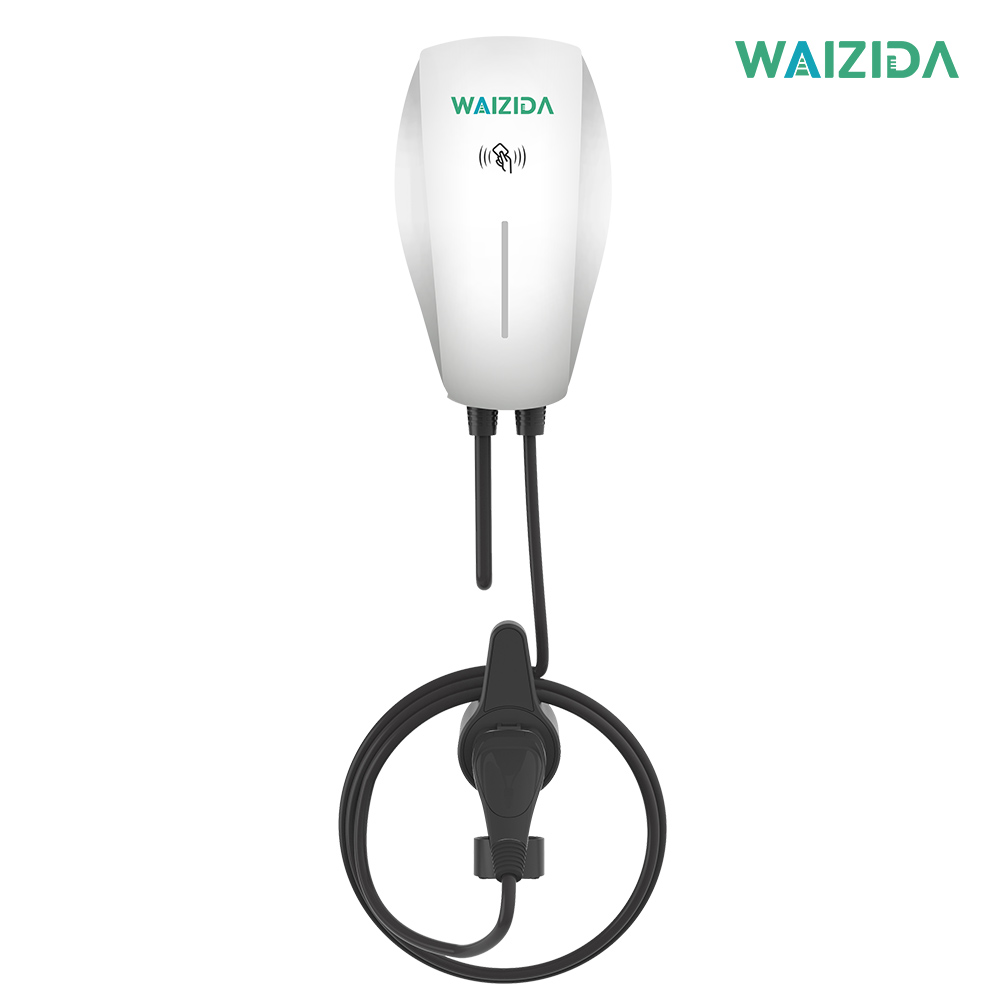
For environmentally conscious users who prioritize technological adaptability and a minimalist architectural aesthetic, the untethered configuration presents a highly compelling alternative. It is a stark contrast to the traditional fixed-cable approach.
A socket wallbox is an advanced charging unit that strictly omits the built-in charging cable. Instead, the face of the sleek enclosure features a universal female receptacle. Most commonly, this is a standardized Type 2 socket in many global markets. To initiate the flow of electricity, the user must provide their own separate, double-ended charging cord. You plug one end securely into the wall hardware and the other end directly into the vehicle. Conceptually, it functions exactly like a standard household wall outlet.
The modular nature of the untethered design offers distinct, highly practical long-term benefits for forward-thinking property owners.
Universal Compatibility: A socket unit acts as a universal power source. If a family member arrives for the weekend with a completely different vehicle make, they simply pull their own compatible cable from their trunk and connect without issue.
Maximum Future-Proofing: Automotive charging standards inevitably evolve. However, the core electrical infrastructure on your wall remains perfectly viable. If you change vehicles and require a different connector type, you only need to purchase a new loose cord. This protects your expensive initial hardware investment.
Clean Architectural Aesthetics: When the charging session is complete and the cord is stored away, the wallbox remains a sleek, unobtrusive box on the wall. There are no heavy, looping wires drawing the eye down the side of the building.
Customizable Lengths: Users are absolutely never restricted by manufacturer defaults. You can purchase a short 6-foot cord for tight spaces to minimize tripping hazards. Alternatively, you can invest in a massive 35-foot cord for extended driveway reach.
In contrast to its immense flexibility, the socket design fundamentally introduces daily operational friction. Some drivers find this highly irritating over time.
The Daily Hassle: The physical process of initiating a charge requires noticeably more manual effort. The user must pop the trunk, uncoil the cord, plug it into the wall, plug it into the car, and then reverse that entire tedious process the next morning.
Wet and Dirty Cords: If the vehicle is charged outdoors during inclement winter weather, the loose cord inevitably rests on wet leaves, snow, or muddy asphalt. Storing that dirty equipment back into the pristine trunk of a luxury vehicle can be highly frustrating.
To facilitate a clear, objective decision-making process, we must evaluate both options across standard real-world operational metrics. The table below breaks down how each configuration performs in daily scenarios.
| Evaluation Metric | Socket Wallbox (Untethered) | Tethered Wallbox |
|---|---|---|
| Daily Convenience | Lower - Requires manual cable handling | Higher - Seamless plug-and-play operation |
| Vehicle Compatibility | Universal - Compatible with any user cable | Fixed - Limited to the hardwired connector |
| Aesthetics Idle State | Clean, sleek, and minimalist | Bulky - Visible cable storage required |
| Hardware Longevity | Highly future-proof | Vulnerable to connector obsolescence |
| Maintenance | Easy - Replace a damaged cable instantly | Hard - Requires professional electrical repair |
When analyzing upfront costs, an untethered unit often appears marginally cheaper. The manufacturer is not supplying twenty feet of heavy-duty, expensive copper wiring in the box. However, this is frequently a false economy. If your newly purchased electric vehicle did not come with a compatible public charging cord in the trunk, you must purchase one separately. High-quality, safety-certified EV cords can be quite expensive. This often makes the total initial financial output for a socket setup noticeably higher. Conversely, in the long term, if a fixed cable is violently run over and crushed by a car tire, replacing the entire hardware unit is significantly more expensive than simply ordering a new loose cord.
Both high-quality socket and tethered units are engineered to strict ingress protection standards. Look for robust IP54 or IP65 ratings. These ratings ensure the delicate internal electronics are heavily shielded against driving rain, sleet, and airborne dust. However, the physical installation location heavily dictates the preferred choice. For outdoor driveway installations, untethered units are often heavily preferred by strict homeowners associations due to their discreet appearance. Inside a private, enclosed garage, harsh weather is a non-factor. Here, the immediate plug-in convenience of a tethered unit almost always wins out.
Security is a highly valid concern for any outdoor electrical installation. A fixed cable is hardwired deep into the unit's chassis. It is incredibly difficult to steal without specialized cutting tools, exposed live wires, and significant time. Loose cords used with socket units are theoretically much easier to target by opportunistic thieves. Fortunately, modern untethered hardware features advanced electronic locking mechanisms. Once the cord is plugged in and the charging session is digitally authenticated via an app or RFID card, the wall unit physically locks the cord into the socket with a motorized pin. It absolutely prevents unauthorized removal until the vehicle owner actively stops the session.
Selecting the optimal power delivery system requires a brutally honest assessment. You must evaluate your specific logistical environment, daily habits, and long-term vehicle ownership strategy.
Recent market analyses and infrastructure reports highlight a massive transition in the automotive sector. Major automakers are aggressively adopting new connector standards and moving away from legacy plugs. Consequently, the fear of hardware obsolescence is at an all-time high among consumers. Industry experts point out that this specific volatility is driving a noticeable shift in preference toward modular, untethered configurations in many regions. Rather than ripping out an entire hardwired system when purchasing a next-generation vehicle, property owners are favoring the adaptability of socket units. This modular approach serves as an excellent hedge against industry unpredictability.
If your busy household operates a mixed fleet, an untethered configuration is undeniably the most logical choice. For instance, you might have an older commuter EV utilizing a standard Type 1 port parked alongside a brand-new luxury EV utilizing a modern NACS port. A socket setup entirely prevents the frustrating need to constantly attach and detach bulky adapters to a fixed cable. Relying on adapters daily not only introduces annoying extra steps, but it also increases wear on the delicate connector pins. It can even introduce potential points of electrical resistance.
Spatial logistics and cable management are critical safety factors. If you park in a narrow, cluttered garage, a long tethered cable can quickly become a severe tripping hazard. This happens if you fail to meticulously coil it after every single use. In this specific scenario, a socket unit paired with a custom, ultra-short cord is vastly safer. In contrast, you might park in a wide, multi-car driveway. If you tend to park in wildly different orientations depending on the day, a tethered unit equipped with a maximum-length 25-foot cable ensures you can always reach the charge port.
The intended use case heavily dictates the final hardware selection. For private, single-family homes, pure convenience is paramount. This drives the massive popularity of fixed-cable units. However, the hardware might be installed in a shared residential complex, an apartment building parking garage, or a commercial workplace. In these scenarios, installing a reliable EV charging station with a socket configuration is the absolute industry standard. Untethered units seamlessly accommodate all employee or tenant vehicle types. Furthermore, they completely eliminate the high risk of vandalism, drive-over damage, and cord degradation associated with exposed, permanent cables in unmonitored public spaces.
Regardless of whether you ultimately select a modular or fixed configuration, the internal computing capabilities of the unit should never be overlooked. The global market has rapidly shifted away from standard dumb chargers that merely dispense electricity. We are moving toward highly intelligent, network-connected hardware ecosystems.
A modern smart unit connects directly to your local Wi-Fi or cellular network. This allows for comprehensive remote management via a polished smartphone application. Key software features include real-time energy monitoring. This provides empirical, granular data on exactly how many kilowatt-hours your vehicle consumes each month. Additionally, smart units often incorporate Radio Frequency Identification technology. By simply tapping a registered RFID card on the face of the unit, users can instantly authenticate charging sessions. This prevents unauthorized neighbors or passersby from stealing your electricity if the unit is mounted outdoors.
Perhaps the most critical technical function of a modern smart unit is dynamic load balancing, commonly referred to as DLB. Standard residential electrical panels have a very finite maximum capacity. If an EV is aggressively pulling 11 kW of power while the home's HVAC system, electric oven, and clothes dryer are running simultaneously, it can easily trip the main breaker. Smart chargers actively monitor the home's total electrical load in real-time. They automatically throttle the EV's charging speed down to prevent overloading the grid. They safely ramp it back up the moment household appliances are turned off. Furthermore, smart scheduling allows the unit to purposely delay charging until utility rates drop to their lowest midnight tier. This ensures maximum economic efficiency without requiring you to walk out to the garage at 1:00 AM.
The final decision between a modular and fixed unit ultimately hinges on finding the perfect balance. You must weigh daily operational convenience against long-term hardware adaptability. Making the right choice requires sourcing your equipment from manufacturers with a proven, verifiable track record of safety, durability, and technological compliance.
When evaluating charging hardware, it is absolutely imperative to look beyond slick surface aesthetics. Deeply examine the engineering standards of the provider. The market is unfortunately flooded with cheap, uncertified units that pose severe fire risks. Equipment must meet strict regional safety certifications, such as UL in North America or CE and TUV in Europe. This ensures it can safely handle continuous, high-voltage electrical loads for hours on end. Reputable manufacturers focus heavily on robust internal thermal management systems. They utilize high-quality relay components, such as built-in Type A and DC 6mA leakage protection, to fiercely protect the consumer's financial investment.
No two charging environments are perfectly identical. Working with a versatile technology provider ensures you never have to compromise on your specific logistical requirements. You might need a highly durable tethered setup for rapid daily departures in a private garage. Alternatively, you might be a property manager looking to deploy a fleet-ready network of untethered units. Variety is key. It is highly recommended to explore a range of premium home wallbox products designed specifically to meet rigorous industrial and residential standards. By perfectly aligning your hardware choice with your specific parking logistics, you establish a robust charging infrastructure that serves you flawlessly for years.
Selecting the perfect charging infrastructure dramatically improves your daily EV ownership experience. A fixed-cable unit offers unmatched daily plug-in convenience, saving you precious time and effort every single morning. In contrast, an untethered version provides maximum long-term flexibility, cleaner aesthetics, and brilliant future-proofing against shifting industry standards. Your ultimate choice depends heavily on your specific parking situation, aesthetic preferences, and whether the unit will serve a single car or a diverse fleet. Evaluate your current vehicles and future driving needs carefully. To ensure a safe, highly efficient power delivery system that aligns perfectly with your lifestyle, explore the premium WAIZIDA Model C2 series and other safety-certified charging solutions available at Regital New Energy. Finding the exact match for your garage has never been easier.
Generally, no. Tethered and untethered units are engineered and hardwired entirely differently at the internal circuit board level to meet highly specific safety regulations. Attempting to manually convert them cuts into live wiring. This immediately voids manufacturer warranties and introduces severe electrical fire hazards. It is highly recommended to make the correct structural choice prior to your initial installation.
The physical wall unit itself is often slightly cheaper upfront because it does not include the heavy, expensive copper charging cable in the box. However, you must account for the additional cost of buying a separate, high-quality charging cord. When combined, this often makes the total financial investment equal to or slightly greater than buying an all-in-one tethered model.
Yes, provided the driver possesses the correct corresponding cable. The wall unit features a universal female receptacle. As long as the driver's personal cord has a connector that fits the wall unit on one end and a connector that perfectly matches their specific vehicle's port on the other end, the vehicle will communicate and charge successfully.
Absolutely. Because these powerful units operate on a high-voltage 240V circuit and draw continuous, heavy electrical loads for several hours at a time, professional installation is legally mandatory in most jurisdictions. A certified electrician ensures the wiring meets local building codes, integrates proper earth grounding, and prevents catastrophic potential fire hazards.
This depends entirely on the fixed cable length provided by the manufacturer, which typically ranges from 16 to 25 feet. Before purchasing a fixed unit, you must physically measure the distance from the planned wall installation site to your vehicle's specific charging port location. Always remember to account for necessary slack and routing the cable safely around the vehicle's body.
Type 1 connectors are primarily used in older North American and Japanese vehicles, featuring a 5-pin design that supports single-phase charging. Type 2 connectors are the standard across Europe and many other regions, utilizing a 7-pin design that supports both single-phase and significantly faster three-phase charging. When using an untethered wallbox, you simply purchase the cable that matches your vehicle's specific inlet type.
While it is technically possible to leave your personal cable plugged into an untethered unit, it defeats the primary aesthetic purpose of the socket design. Furthermore, leaving a loose cable permanently exposed to harsh weather conditions or lying on a garage floor increases the risk of moisture ingress and physical damage. It is highly recommended to unplug and properly store the cable after each charging session.

The adoption of electric vehicles is accelerating in Latin America, with Costa Rica leading the way. The country boasts abundant renewable energy (over 98% clean electricity) and a strong commitment to decarbonization, providing an ideal environment for building electric vehicle charging infrastructure.

Waizida Unlocks New Capabilities with Fully Integrated Circuit Board ManufacturingWaizida has achieved a critical milestone in vertical integration: we now possess complete in-house capability for the research, design, and production of the core printed circuit boards (PCBs) for our EV charging stat

From March 5th to 7th, 2025, the 18th Italy International Renewable Energy Exhibition (KEY Energy 2025) kicked off at Rimini Expo Centre in Italy. As an innovative player in the global new energy charging sector, Waizida showcased its brand-new charging pile series at the exhibition, demonstrating i

Las Vegas, March 22, 2024 — From March 20 to 22, Waizida successfully participated in the 2024 U.S. EV Charging Summit & Expo held in Las Vegas, gaining significant industry attention.As one of the key global platforms for electric vehicle charging technology and infrastructure, the summit attracted


