New Energy, New Idea, New Life

Views: 0 Author: Site Editor Publish Time: 2026-10-14 Origin: Site


Imagine pulling into your driveway after a grueling day at the job site or office. You grab the thick charging cable and push the connector into your vehicle's charge port. You hear the heavy, satisfying mechanical click of the latch seating into place. You head inside to relax. This routine feels undeniably convenient. Yet, executing it at the wrong time of day acts as a silent drain on your household budget. Many electric vehicle owners inadvertently plug in their cars during peak grid demand hours. The ultimate result is paying the absolute highest premium for everyday power.
Utility companies actively combat grid congestion by offering specialized pricing structures. This is precisely where off-peak timing comes into play. By installing a dedicated Level 2 EVSE, you automate your entire energy consumption profile. The internal contactors will only close to deliver power when electricity rates plummet overnight. This technical guide breaks down the mechanics of smart energy management. We will analyze hardware versus software control logic, outline critical equipment parameters, and provide field-tested configuration steps to maximize your return on investment.
Objective Cost Reduction: Shifting charging sessions to off-peak hours mathematically slashes electricity costs. Depending on your local utility provider, savings frequently exceed 50 percent per session.
Hardware Superiority: Utilizing dedicated smart hardware ensures a highly stable execution environment. This completely bypasses the notoriously buggy communication loops found in native vehicle applications.
Conflict Prevention: You must designate either the car or the wall station as the primary controller. Running competing timers simultaneously remains the leading cause of morning charging failures.
Protocol Standards: Selecting open-source equipment guarantees forward compatibility. This is essential for advanced grid integration, utility rebates, and complex daily routines.
Before diving into residential setups, we must look at the broader energy sector. Industry analysts note a massive shift toward utility-managed infrastructure, often referred to as active demand response or V1G. As adoption accelerates, local grids face unprecedented evening loads. Consequently, power providers are rapidly moving away from static rate tiers toward dynamic pricing models. They now offer heavy financial rebates to customers who allow their equipment to be slightly throttled during extreme grid stress.
This macro trend dictates residential purchasing decisions. Hardware lacking open-source communication protocols will struggle to participate in these lucrative incentive programs. Investing in standardized, network-capable equipment is no longer just about personal convenience. It has become a strict prerequisite for capturing future utility rebates and supporting overall grid resilience.
To truly understand how timing impacts the total cost of ownership, we need to examine grid load management. Utility companies must distribute electricity to residential neighborhoods without causing transformer blowouts.
Electricity is rarely priced at a flat rate across all hours of the day in modern grids. To prevent catastrophic overload during high-demand periods, utility providers implement Time-of-Use pricing. This economic structure charges consumers a premium when demand surges. Conversely, it offers steep discounts when demand subsides.
Peak hours typically occur between 4:00 PM and 9:00 PM. This represents the critical window when residential consumption spikes. Families return home, activate HVAC systems, and run large household appliances. Off-peak hours generally span from late evening around 10:00 PM to early morning. During this quiet window, overall grid demand drops significantly. Utility companies incentivize consumption by drastically lowering the price per kilowatt-hour.
Hardware equipped with scheduling software acts as an intelligent gatekeeper for electrical current. The mechanical process is straightforward but highly effective for daily management.
You arrive home at 5:30 PM and plug in. The physical connection is immediate. However, the internal microprocessor intercepts the power flow. It cross-references the schedule configured in your mobile app. If your rules dictate charging should only occur between midnight and 5:00 AM, the station communicates a digital wait signal to the vehicle. The power flow remains completely suspended. Once the internal clock strikes midnight, the relays snap closed. Power delivery begins instantly at the absolute lowest utility rate.
Relying on a standard 120-volt wall outlet is insufficient for effective energy management. To maximize economic benefits, your residential infrastructure must deliver substantial power within a heavily restricted time frame.
Off-peak utility windows are finite. Some energy providers offer highly lucrative super off-peak rates that only remain active for four to six hours in the dead of night. A standard Level 1 cable delivers a mere 1.4 kilowatts of power. This trickles about 3 to 5 miles of range per hour into the battery. If your discount window is only five hours long, you will barely replenish 20 miles of range. That is hardly enough for a standard daily commute.
In contrast, a 240-volt smart EV charger outputs between 7.2 kilowatts and 11.5 kilowatts. This translates to a robust 20 to 35 miles of range added per hour. This enhanced capacity ensures your vehicle easily recovers from a depleted state entirely within a strict four-hour window. You secure maximum financial savings without ever compromising your morning driving readiness.
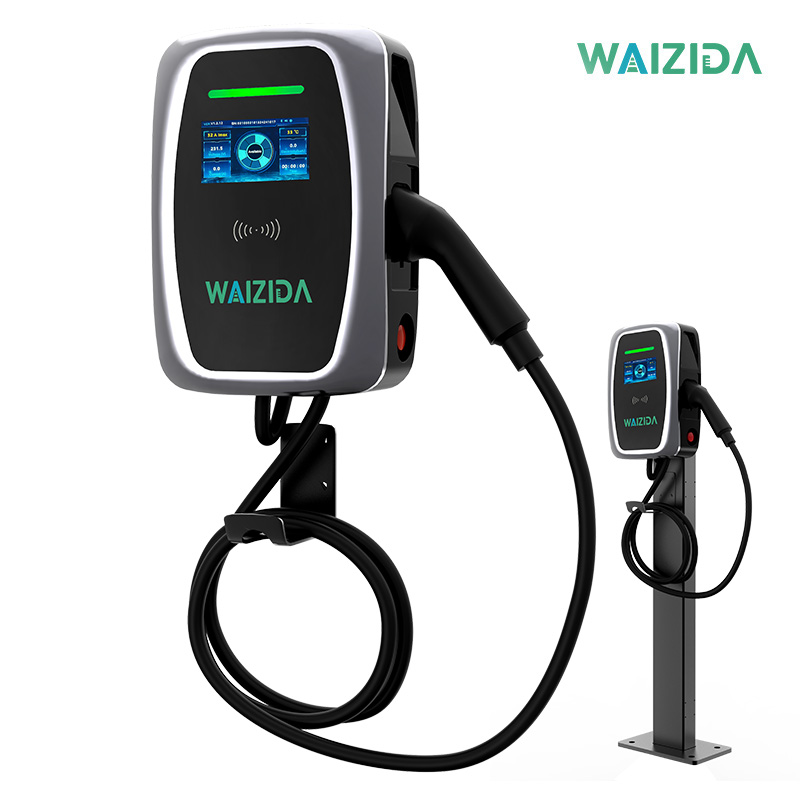
Upgrading your garage requires looking past basic specifications. You need industrial-grade reliability. Field experience shows that equipment like the Regital WAIZIDA Model A provides the exact parameters needed for flawless scheduling.
First, look for adjustable power outputs. Units offering selectable 7kW, 11kW, or 22kW capacities allow you to match the station to your home's specific electrical panel limits. Furthermore, outdoor installations demand rigorous weatherproofing. An IP65 enclosure rating ensures the internal microprocessors remain completely protected from heavy rain and dust storms. This prevents the timer from short-circuiting during severe weather.
One of the most fiercely debated topics among owners involves determining which system should dictate the routine. Both the automobile and the wall equipment possess timer capabilities. Yet, their operational reliability differs significantly based on software architecture.
| Comparison Factor | EVSE Hardware Scheduling | Vehicle App Scheduling |
|---|---|---|
| Connection Stability | High. Hardwired to home Wi-Fi with local memory backup. | Low. Relies on cellular signals that frequently drop in concrete garages. |
| Multi-Vehicle Support | Excellent. Applies the same off-peak rules to any plugged-in brand. | Poor. Requires configuring separate clunky apps for different car brands. |
| Sleep Mode Issues | None. The wall station is always awake and ready to push power. | High risk. Cars enter deep sleep to save 12V batteries and fail to wake up. |
| Battery Percentage Data | Blind. Only knows how much energy is dispensed, not the battery fullness. | Precise. Can stop charging exactly at 80 percent to preserve cell health. |
Delegating timer responsibilities to the stationary hardware elegantly bypasses automotive software limitations. Because the equipment is bolted to your wall, it typically maintains a rock-solid connection to your home router. It integrates seamlessly with local utility data.
If a household owns multiple electric vehicles from different brands, a single unit enforces the exact same off-peak rules for any car plugged into it. This entirely eliminates the frustration of configuring multiple automotive apps. The only minor drawback is that standard charging protocols do not transmit the vehicle's exact battery percentage back to the station.
The most critical error a new owner can make is configuring a timer on both the car and the wall unit simultaneously. This creates a frustrating technical paradox known as a handshake conflict.
Specifically, if your car is programmed to accept power at 10:00 PM, it sends a request through the cable at that exact moment. However, if your wall equipment is programmed to wait until 11:00 PM, it outright denies the car's request. By the time 11:00 PM rolls around and the station finally offers electricity, the vehicle has likely timed out. It records an error and goes back to sleep. One of these schedules must be completely deactivated.
Proper digital configuration is essential for seamless daily operation. By following these empirical steps, you can perfectly synchronize your time-of-use scheduling wallbox with your local grid pricing tiers.
Before altering any digital settings, you must verify your exact rate structure. Log into your utility provider portal or review a recent paper billing statement. Look for specific programs labeled EV Rate Plans. Pay close attention to the exact minute the off-peak window begins and ends. Complete any required formal enrollment processes first.
Open the companion application for your hardware and navigate to the energy management tab. Carefully input your start time and stop time. Next, input your specific peak and off-peak cost per kilowatt-hour. Adding this pricing data allows the software algorithm to accurately calculate your accumulated financial savings over the lifespan of the equipment.
To prevent the dreaded handshake conflict, physically sit in your vehicle and navigate to the dashboard menus. Delete any existing location-based timers, departure schedules, or delayed rules. Set the vehicle preference to charge immediately when plugged in. By establishing this baseline, the car passively accepts power whenever the external equipment decides it is financially optimal to supply it.
As the mobility market matures, the hardware used to power these vehicles has evolved into highly sophisticated technology. A modern hub effectively acts as an intelligent energy management center for your entire home.
When evaluating hardware longevity, Open Charge Point Protocol compliance is a critical specification. An OCPP charger utilizing the 1.6J standard speaks a universal communication language. This allows the station to interact seamlessly with various central management systems and third-party utility networks. You are never locked into a single manufacturer's proprietary ecosystem.
To truly verify the financial benefits of off-peak charging, objective data is required. High-quality equipment features integrated energy metering. This tracks exact consumption down to the decimal point.
By cross-referencing the dispensed electricity with the custom rates entered during setup, the software automatically calculates the exact cost of each session. Over time, these applications generate comprehensive visual reports. They estimate the precise dollar amount saved by avoiding peak hours. This empirical data provides transparent proof of your return on investment.
Even with premium hardware, the digital interaction between a station and an electric vehicle can occasionally encounter technical friction. Understanding the underlying mechanics of these communication failures allows for rapid resolution.
When a scheduled session fails to initiate, the root cause typically stems from a deep sleep handshake failure. You plug in at 6:00 PM but the schedule does not start until midnight. The car computer falls into a deep sleep to conserve battery. When the station finally sends the wake-up signal at midnight, the car fails to respond. Ensuring your app has a wake-up ping feature enabled often solves this.
Additionally, prolonged router dropouts can disrupt cloud-dependent hardware. To mitigate this, prioritize equipment that saves parameters locally on its internal memory board. This ensures execution regardless of internet status.
There will inevitably be times when you need to bypass your carefully planned routine. Preparing for an unexpected long-distance trip in the middle of a high-cost afternoon requires an intuitive manual override.
Most advanced applications feature a prominent override button on the home screen. Furthermore, look for hardware that includes a physical method of override. Units like the WAIZIDA Model A allow you to swipe an RFID card directly on the casing. This provides highly valuable redundancy if your smartphone is dead or the local network is temporarily offline.
Procuring the right equipment is only half the equation. How you utilize that equipment dictates the actual longevity of your battery pack and the true extent of your financial savings.
A fundamental principle within the engineering community is the Always Be Plugged In rule. Many new owners mistakenly treat their cars like gasoline vehicles. They wait until the battery drops to 10 percent before connecting for a massive, prolonged session.
Lithium-ion battery management systems perform vital background maintenance tasks. By connecting to your home wallbox every time you park, the vehicle pulls a tiny trickle of grid power to heat or cool the battery pack as needed. It avoids draining its own reserves. As long as your off-peak timer is active, the heavy bulk charging remains restricted to the cheapest hours. Meanwhile, the battery stays perfectly conditioned year-round.
For households equipped with photovoltaic solar arrays, the definition of off-peak changes entirely. Instead of waiting for grid rates to drop at midnight, the most economical time to charge is during peak solar production in the middle of the day.
Advanced hardware integrates directly with solar inverters using current transformer clamps. These sensors monitor the exact amount of excess solar energy being generated by your roof. The software dynamically adjusts the charging speed to match this excess output perfectly. This incredible synergy effectively allows your vehicle to run on pure, self-generated renewable energy.
Upgrading to dedicated Level 2 hardware is a highly strategic investment. It rapidly pays for itself through significantly lower monthly electricity bills. By shifting your energy consumption away from peak grid hours, you protect your household budget while ensuring your vehicle is always ready for the morning commute.
When selecting your equipment, prioritize reliable hardware that features open-source OCPP protocols, robust local memory, and physical RFID overrides. Take the time to properly configure your off-peak hours and disable conflicting in-car timers. Let the technology handle the heavy lifting of daily energy management.
Ready to modernize your daily driving routine and slash your utility bills? Browse the premium selection of smart charging equipment at Regital New Energy. Whether you need the rugged IP65 protection of the WAIZIDA Model A or advanced load balancing features, reach out to our expert team for personalized installation advice tailored to your specific grid requirements.
Yes. The charging station will safely recognize the physical connection but will intentionally pause the power flow. The electricity will not begin transferring to the vehicle battery until your pre-programmed off-peak window officially begins. This ensures you never accidentally pay peak rates.
While not strictly mandatory, relying on a dedicated wall unit is significantly more reliable. Built-in vehicle apps frequently suffer from cellular connectivity bugs or deep sleep conflicts that result in failed morning charges. Hardware-level scheduling bypasses these common automotive software limitations entirely.
High-quality smart units are designed to save your timing parameters locally on their internal memory boards. This intelligent engineering means your relays will still close exactly on time, even if your home router loses its active internet connection during a severe storm.
Yes. The hardware acts as the primary digital gatekeeper for the power supply. It treats any plugged-in vehicle exactly the same. It flawlessly applies your established off-peak power rules regardless of the specific car brand, model, or battery size connected to the cable.
No, it actually helps preserve battery health. By scheduling your sessions, you allow the battery to cool down after your evening commute before receiving a massive influx of power at midnight. Furthermore, keeping the car plugged in allows the thermal management system to use grid power to keep the cells at an optimal temperature.
Savings vary wildly based on your local utility provider, but they are substantial. In regions with aggressive dynamic pricing, peak electricity can cost upwards of $0.40 per kilowatt-hour, while off-peak rates drop to $0.10. For a standard 70kWh battery, shifting your charge time can save you roughly $20 per full charge, translating to hundreds of dollars in savings annually.

The adoption of electric vehicles is accelerating in Latin America, with Costa Rica leading the way. The country boasts abundant renewable energy (over 98% clean electricity) and a strong commitment to decarbonization, providing an ideal environment for building electric vehicle charging infrastructure.

Waizida Unlocks New Capabilities with Fully Integrated Circuit Board ManufacturingWaizida has achieved a critical milestone in vertical integration: we now possess complete in-house capability for the research, design, and production of the core printed circuit boards (PCBs) for our EV charging stat

From March 5th to 7th, 2025, the 18th Italy International Renewable Energy Exhibition (KEY Energy 2025) kicked off at Rimini Expo Centre in Italy. As an innovative player in the global new energy charging sector, Waizida showcased its brand-new charging pile series at the exhibition, demonstrating i

Las Vegas, March 22, 2024 — From March 20 to 22, Waizida successfully participated in the 2024 U.S. EV Charging Summit & Expo held in Las Vegas, gaining significant industry attention.As one of the key global platforms for electric vehicle charging technology and infrastructure, the summit attracted


